Many people hear the term OCD and assume it simply means being very clean or organized.
In reality, Obsessive-Compulsive Disorder (OCD) is much more complex. It affects how a person thinks and feels.
At Bio Psychiatry Therapeutic Services, LLC, we understand how hard this can be. We provide compassionate telepsychiatry care for children, adults and seniors. We help people with OCD understand how their minds work and how to feel better in daily life.
Below, we explain how OCD creates false thoughts, why it happens and how treatment can help.
What Is OCD?
OCD is a mental disorder.
It has two main parts:
- Obsessions: thoughts that keep coming back
- Compulsions: actions you do to feel less worried
Intrusive thoughts often affect people with OCD. They can be intense and hard to handle. Some people may also feel OCD sensations or uncomfortable physical urges. These can make the thoughts seem even more real.
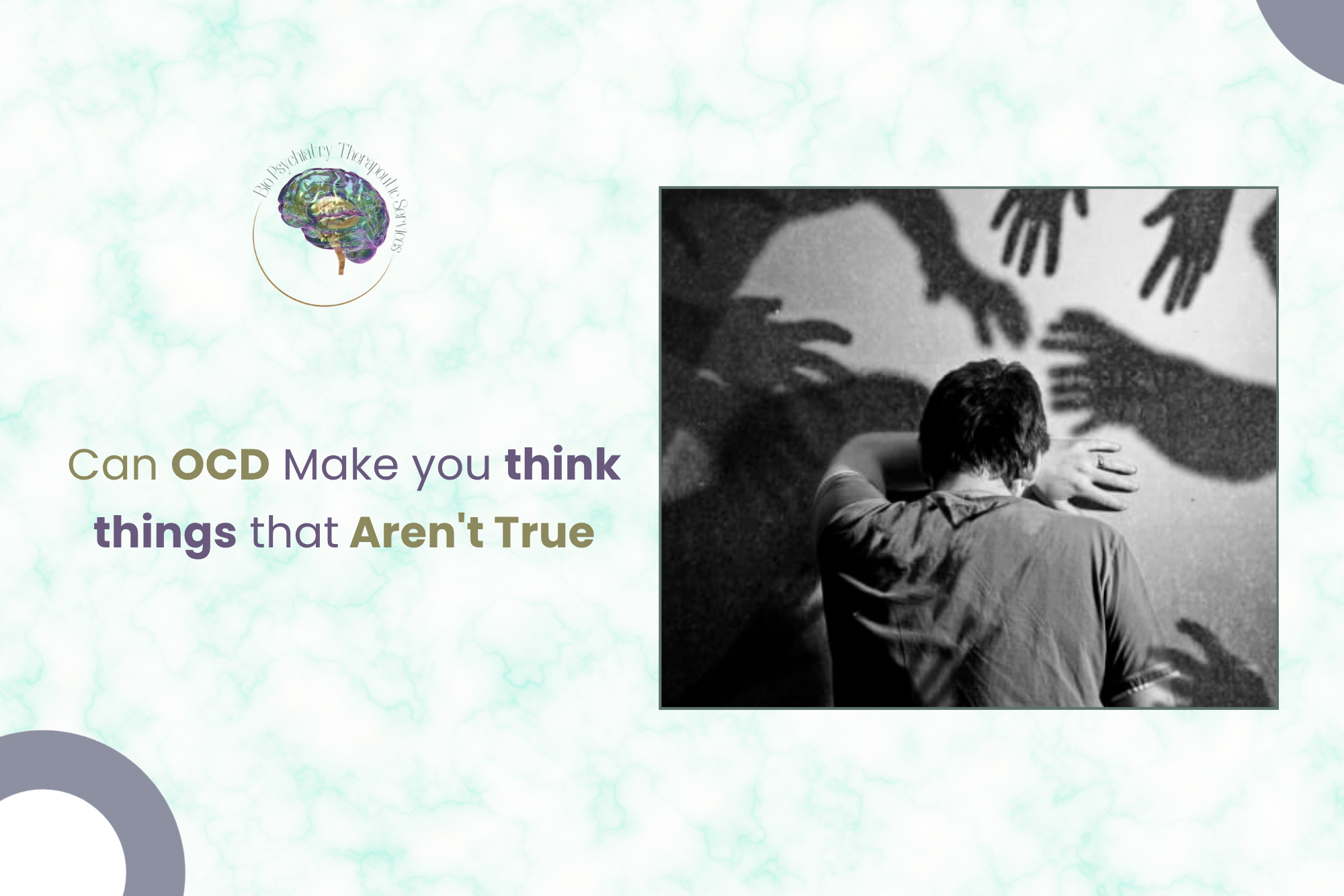
Can OCD Make You Think Things That Aren’t True
Yes. OCD can produce intrusive thoughts that feel real but are not based on facts.
These thoughts are typically:
- Sudden
- Unwanted
- Repetitive
- Distressing or confusing
The key thing to remember is: OCD is driven by fear, not truth.
For example:
- A kind person may fear they are dangerous
- A responsible person may believe they made a serious mistake when they didn’t
- A loving parent may worry that they could harm someone they care about
These thoughts do not reflect a person’s character, they are symptoms of OCD.
False Memory OCD Explained
Some individuals experience what is commonly called false memory OCD.
This involves persistent doubt about past events, where the brain creates uncertainty or “fills in gaps” with fear-based assumptions.
Examples include:
- Believing you said something hurtful when you didn’t
- Thinking you made a mistake at work without evidence
- Feeling unsure about actions you clearly remember
Although people may search for “false memory disorder,” in this context, it is not a separate diagnosis, it is a manifestation of OCD.
Why OCD Creates False Thoughts
The brain is designed to protect you from danger. In OCD, this system becomes overactive.
The brain does not overlook minor concerns; instead, it considers them important threats. This results in recurrent thoughts that are considered urgent and important.
This happens in a cycle:
- A thought appears
- It causes fear or stress
- The person tries to fix or check it
- The brain repeats the thought for certainty
Trying to remove a thought can make it stronger. This is why OCD feels stuck and is hard to control.
What Causes OCD to Get Worse
OCD can worsen due to various factors. Here are some key triggers:
- Stress
- Lack of sleep
- Avoidance of fears
- Excessive compulsive behaviors
OCD can also get worse with:
- Major life changes
- Trauma
- Untreated anxiety and depression
Recognizing these triggers can help in managing OCD effectively.
How OCD Thoughts Feel Real
One of the hardest parts of OCD is that thoughts feel real.
This happens because:
- The brain sends strong emotional signals
- Fear makes thoughts feel important
- Repetition makes thoughts feel true
Even when a person knows “this does not make sense,” the feeling inside says something different.
This is why OCD is not about logic. It is about fear and doubt.
How OCD Affects Daily Life
Living with OCD can be exhausting. People may feel:
- Constant worry
- Mental fatigue
- Trouble focusing
- Guilt or shame
- Confusion about what is real
Some people also start avoiding situations that trigger their thoughts. This can make life smaller and more stressful.
OCD is treatable. People can take back control of their thoughts.
Treatment for OCD
OCD is treatable and many people improve with proper care.
At Bio Psychiatry Therapeutic Services, LLC, we offer online psychiatric services with an emphasis on recovery and long-term wellness.
Effective treatments include:
Cognitive Behavioral Therapy (CBT)
Helps individuals understand that thoughts are not facts
Exposure and Response Prevention (ERP)
ERP reduces fear by breaking the OCD cycle
Medication Support
May help reduce anxiety and improve brain balance
Simple Ways to Manage OCD Thoughts
Along with professional help, certain small daily routines can help to recover:
- Let thoughts pass without reacting to them
- Remind yourself that thoughts are not facts
- Avoid checking or repeating actions too often
- Practice slow breathing during anxiety
- Talk to a mental health professional when needed
These steps may feel small, but they can help retrain the brain over time.
When to Seek Help
Get help if:
- Thoughts feel uncontrollable
- Anxiety affects daily life
- You feel stuck in mental loops
- You avoid normal activities
- Fear or doubt is constant
Early support can make recovery easier and faster. No one needs to deal with OCD alone.
Conclusion
Can OCD make you think things that aren’t true? Yes, it can. OCD generates intrusive thoughts, which are realistic yet not founded on facts. Intense OCD sensations usually accompany these thoughts, and as such they are further persuasive.
Remember, treatment and support can help you control OCD and its impact on your daily life.
Healing is possible. Life can become calmer and more balanced again.
At Bio Psychiatry Therapeutic Services, LLC, we offer compassionate telepsychiatry care. If OCD thoughts are impacting your life, reaching out for help is a great first step toward feeling better.
FAQs
Is false memory OCD the same as psychosis?
No, people with OCD doubt their thoughts, while psychosis involves strong belief in false ideas without doubt.
How can I stop false memory OCD?
With therapy, medicine, and learning to accept uncertainty.